Creating an Interviewer Agent
The Interviewer agent conducts deep, exploratory research using ethnographic interviewing techniques. Rather than following a rigid script, it lets themes emerge naturally by following the participant's narrative and asking adaptive follow-up questions based on what they share.
When to Use an Interviewer Agent
Interviewer agents excel when you need:
- Emergent insights – You're discovering what you don't know, not validating assumptions
- Participant-led exploration – The conversation should follow their narrative and priorities
- Rich, contextual understanding – You need the story behind behaviors and decisions
- Adaptive questioning – Follow-ups should build on what participants actually say
- Thematic discovery – Patterns should emerge from conversations, not predetermined categories
Ideal use cases:
- User research exploring problems and needs
- Customer experience and journey mapping
- Feature discovery and concept exploration
- Understanding motivations and decision-making
- Churned customer exit conversations
- Early-stage market or product research
How Interviewer Agents Work
Interviewer agents use ethnographic techniques that prioritize:
Active listening – Demonstrating understanding through how questions are framed rather than repetitive acknowledgments
Narrative following – Letting participants guide the conversation to what matters most to them
Emergent themes – Discovering patterns across conversations rather than forcing predetermined categories
Non-leading questions – Encouraging detailed responses without suggesting answers
Natural flow – Moving between topics based on participant responses, not a fixed script
Efficient exploration – Typically asking around 10 questions for research interviews, fewer for simpler topics
Selective acknowledgment – Showing understanding through thoughtful follow-ups rather than constant affirmation
Before You Begin
Define Your Research Space
Rather than specific questions, identify the territory you want to explore:
- What problem space are you investigating?
- What would you like to understand better?
- What decision will this research inform?
- What would surprise you to learn?
Identify Target Participants
Who has the experience or perspective you need to understand?
Consider Your Subject
What product, service, feature, or experience will the conversation focus on?
Creating Your Interviewer Agent
Step 1: Select the Interviewer type
- Navigate to agent creation in Perspective AI
- From the agent type options, select Interviewer
You'll see example prompts to help you get started, such as:
- "How's our new feature working out for customers?"
- "Are we delivering the right value to our customers?"
- "What do customers think about our latest service?"
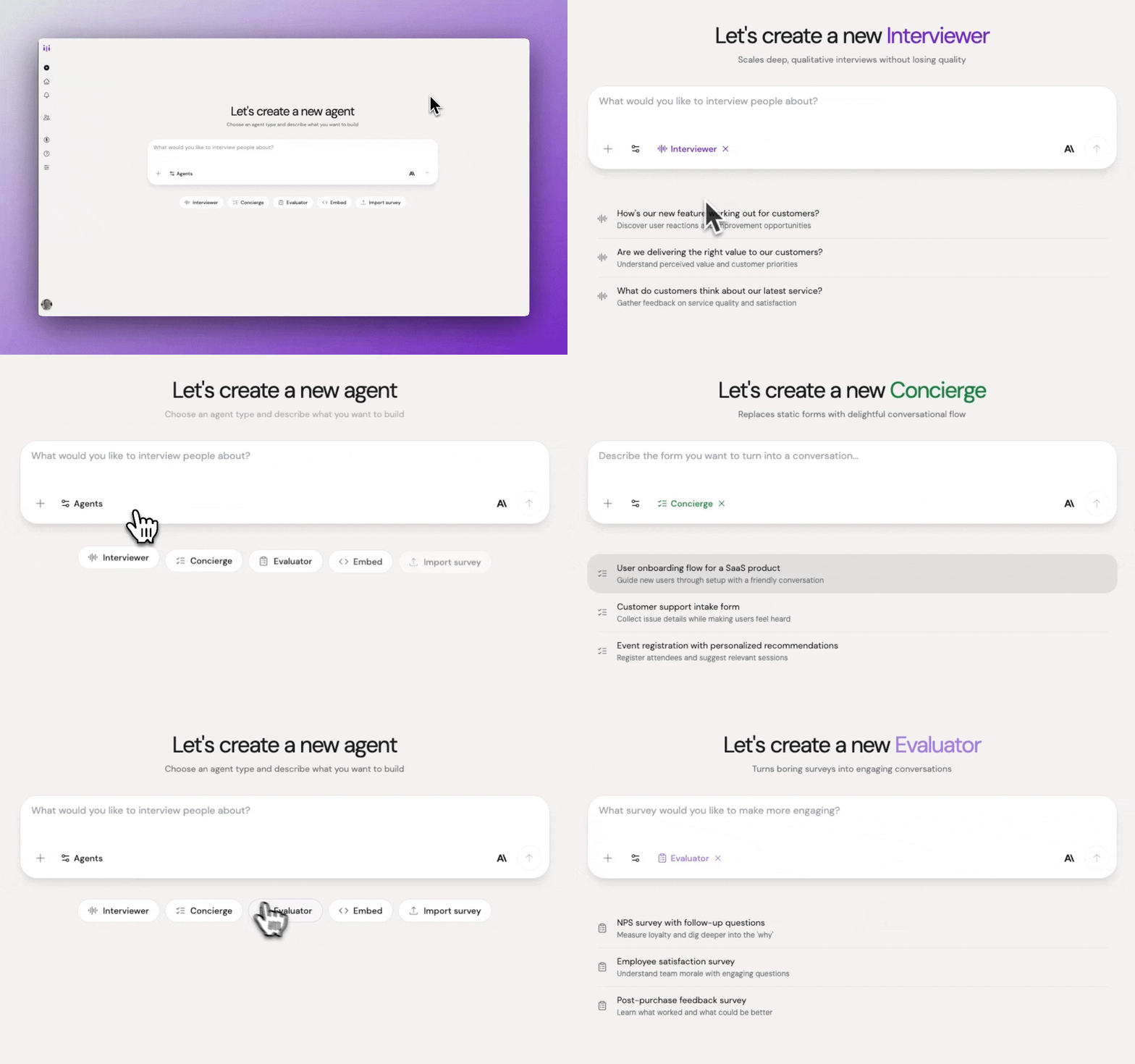
Agent type selection showing Interviewer highlighted
Step 2: Describe what you want to explore
Explain what you want to understand. Perspective will ask you about:
- Your research objective – What do you want to learn?
- Target audience – Who should you talk to?
- Subject – What product, service, or experience are you researching?
- Topic or theme – What specific areas do you want to explore?
Example:
"I want to understand why customers upgrade to our pro plan—what motivates the decision, how they discovered premium features, and what would make the plan more valuable to them."
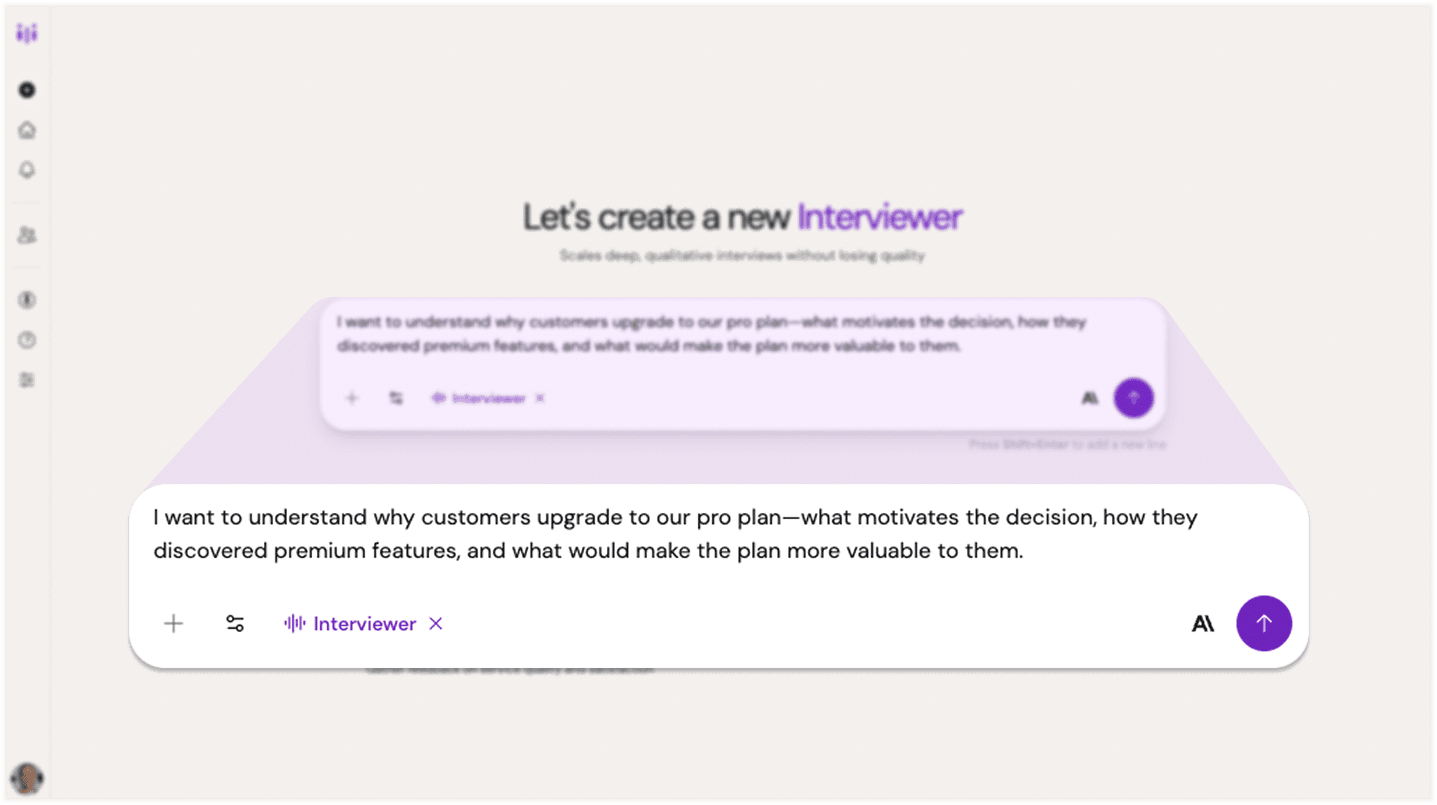
Research question input field
Step 3: Answer clarifying questions
Perspective will assess whether it has enough information to create your outline. If it needs more context about your goals, audience, or focus areas, it will ask targeted follow-up questions to ensure the outline matches your needs.
Step 4: Review the generated outline
Once Perspective has sufficient context, it will generate an outline optimized for your research. The outline includes:
Research question: The core question framing your exploration
Research type: Automatically determined based on your goals (exploratory, evaluative, concept testing, generative, etc.)
Goals: Key objectives the interview should accomplish (typically 3-5)
Participants: Description of your target audience
Interview guidelines: Instructions for maintaining appropriate tone and conversational approach
Methodology: Confirmation of the exploratory interviewing approach
The research type is determined automatically to ensure the interview methodology matches your objectives—whether you're exploring problems, evaluating solutions, testing concepts, or generating new ideas.
Step 5: Refine your agent
Adjust the outline conversationally to match your needs:
Example refinements:
- "Focus more on emotional motivations rather than practical considerations"
- "Make sure to explore what almost stopped them from upgrading"
- "Use a casual, friendly tone—these are power users who know the product well"
- "If they mention competitors, follow that thread deeply"
Each refinement updates your outline while maintaining the exploratory approach.
Step 6: Test the interview
Experience it as a participant would:
- Click Test Interview or Try it Yourself
- Answer thoughtfully as a target participant might
- Evaluate:
- Does it follow interesting threads in your responses?
- Do follow-up questions feel natural and relevant?
- Does it let you share what matters to you?
- Is the tone appropriate?
- Does it feel like exploration, not interrogation?
Step 7: Iterate based on testing
Make adjustments based on your experience, then test again. The goal is a conversation that adapts naturally to what participants share.
Step 8: Invite participants
Once satisfied, invite participants using your preferred method.
Interview Guidelines for Interviewer Agents
Guidelines shape how the agent conducts exploratory conversations.
Default Approach
Interviewer agents naturally:
- Ask open-ended questions that invite narrative responses
- Follow interesting threads in participant responses
- Demonstrate understanding through thoughtful follow-ups
- Probe deeper when participants share something significant
- Maintain conversational flow without feeling scripted
- Acknowledge responses selectively, not repetitively
- Aim for around 10 questions for research interviews, fewer for simpler topics
Customizing Guidelines
Adjust guidelines to match your research context:
For sensitive topics:
"Use empathetic language and give participants space to share at their own pace. If they express frustration or disappointment, acknowledge those feelings before exploring further."
For technical exploration:
"Feel comfortable with technical depth and jargon. When participants mention implementation details or technical trade-offs, follow those threads to understand their reasoning."
For time-efficient exploration:
"Stay focused on core themes. If tangents emerge that don't serve research goals, gently redirect while acknowledging the participant's point."
For maximum openness:
"Follow the participant's energy and interests completely. If they bring up unexpected topics that seem meaningful to their experience, prioritize exploring those fully."
Best Practices for Interviewer Agents
Define the territory, not the questions. Interviewer agents explore a problem space, not execute a questionnaire.
Be clear about your objectives. The more context you provide about what you want to learn, the better the outline will be.
Trust emergent insights. The best discoveries often come from unexpected directions participants take.
Test with varied personas. Different participants will take different paths through the same territory. Test to ensure the agent adapts well.
Use form fields sparingly. Reserve them for essential demographic or factual data that shouldn't interrupt exploratory flow.
Let the agent follow threads. If it explores something you didn't anticipate, there's likely a reason based on participant cues.
Review early transcripts carefully. The first 3-5 interviews reveal whether the agent is uncovering the insights you need.
Iterate between batches. Make refinements after initial interviews rather than waiting until all are complete.
Embrace non-linear exploration. Great exploratory interviews rarely follow a logical sequence.
Common Pitfalls & Fixes
Vague initial description → The more specific you are about your research objectives, audience, and subject, the better your outline will be. Answer clarifying questions thoughtfully.
Too many mandatory questions → These constrain exploratory flow. Use them only for critical information that must be captured.
Overly specific guidelines → Let the methodology work. Guidelines should set tone and boundaries, not script the conversation.
Testing with a single scenario → Different participants will share different experiences. Test varied paths.
Expecting linear flow → Exploratory research follows the participant's narrative, which is rarely linear.
Not leaving room for surprise → If you think you know what you'll learn, you might be over-constraining the exploration.
Forcing thematic categories → Let themes emerge from what participants share rather than fitting responses into predetermined buckets.
Understanding Research Types
Based on your objectives, Perspective automatically determines the most appropriate research approach:
Exploratory – Discovering problems, needs, and opportunities without preconceived solutions
Evaluative – Assessing existing solutions, features, or experiences
Concept Testing – Gathering reactions to proposed ideas or designs
Generative – Creating new ideas and possibilities with participants
Other types – The system adapts to match your specific research goals
You don't need to specify the research type—it's determined automatically to ensure the interview methodology aligns with what you're trying to learn.
Note: While the research type is automatically selected based on your goals, you can request a change if needed by telling Perspective which type you prefer. However, we generally don't recommend this, as the automatic classification is designed to match the methodology to your objectives. Only change the research type if you have specific methodological requirements.
Example Interviewer Agents
Example 1: Feature Discovery
Research goal:
"Understand how power users currently solve [problem area] and what an ideal solution would look like from their perspective."
What Perspective asks about:
- Research objective: Discovery of current workflows and ideal solutions
- Target audience: Power users
- Subject: [Your product/feature area]
- Topic: Problem-solving approaches and needs
Example 2: Cancellation Understanding
Research goal:
"Explore what led customers to cancel in the last 30 days—the full story of their decision, not just the final reason."
What Perspective asks about:
- Research objective: Understanding cancellation decisions
- Target audience: Recently churned customers
- Subject: The product and customer experience
- Topic: Decision-making process and contributing factors
Example 3: Early User Experience
Research goal:
"Understand the first week experience for new users—where they struggle, what delights them, and what shapes their initial impression."
What Perspective asks about:
- Research objective: Early experience evaluation
- Target audience: Users in their first week
- Subject: The onboarding and initial product experience
- Topic: Friction points, moments of delight, and impression formation
Analyzing Interviewer Results
Finding Themes
Read transcripts looking for:
- Recurring patterns – Similar experiences or perspectives across participants
- Unexpected insights – Surprises that challenge your assumptions
- Emotional moments – Strong reactions that signal what truly matters
- Shared language – How participants naturally describe their experience
Extracting Insights
Ask yourself:
- What did I learn that I didn't know before?
- What patterns emerged that I hadn't anticipated?
- What surprised me most?
- What should we explore more deeply?
- What actions do these insights suggest?
Using Form Fields
If you've included form fields for demographic segmentation, use them to:
- Compare themes across user segments
- Identify whether patterns vary by experience level, plan tier, etc.
- Surface key data points for quick filtering
What Makes Interviewer Agents Different
Unlike Concierge agents (which collect specific information efficiently through inference and validation) or Evaluator agents (which systematically assess defined criteria), Interviewer agents prioritize discovery through participant-led exploration. They're designed to uncover what you don't yet know to ask about.
Availability
Interviewer agents are available for all Perspective AI customers. Start conducting scalable exploratory research today.